
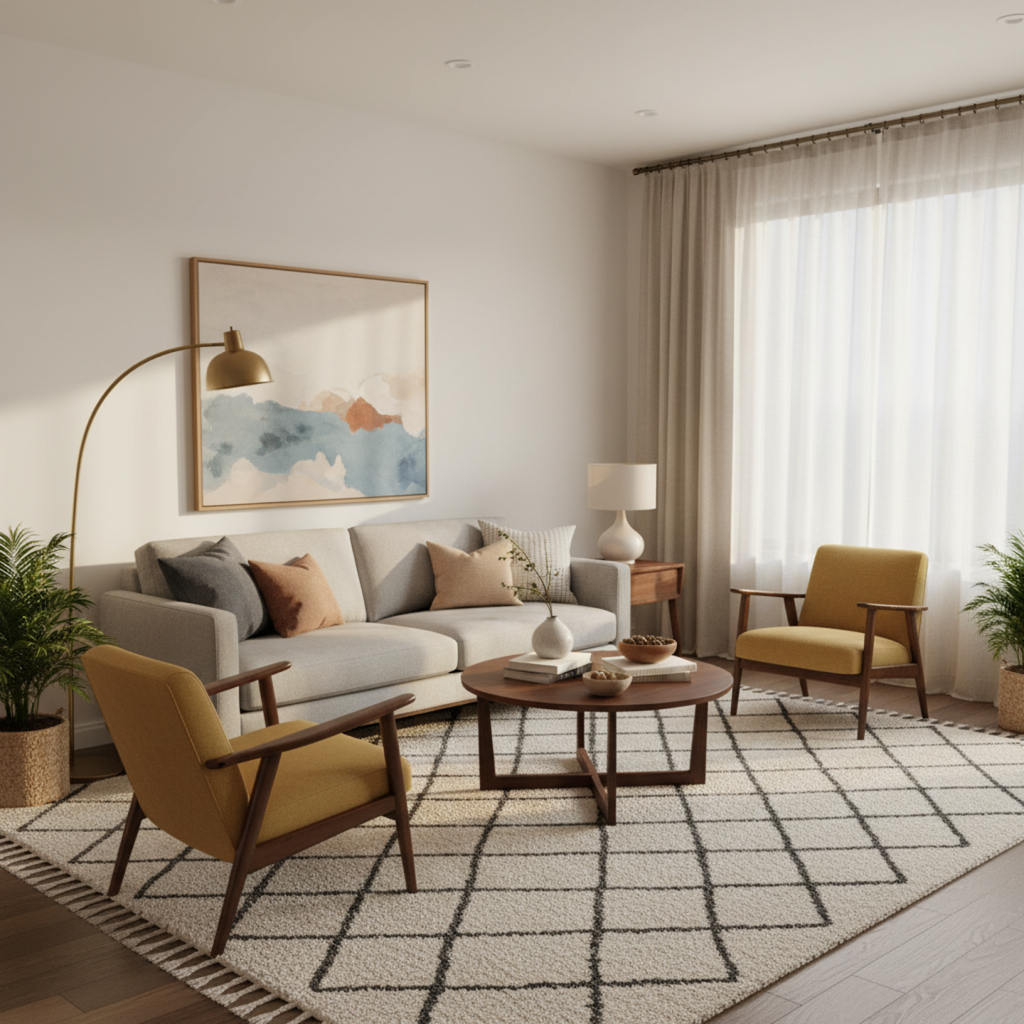
The Hidden Traps of Home Design
The living room. It’s the heart of your home—the stage for quiet mornings, the setting for lively entertaining, and the first impression you make on every guest. Naturally, we pour our energy (and often, our savings) into decorating this space, determined to create a haven that looks straight out of a magazine.
But here’s a confession from the design world: it’s not the expensive marble coffee table or the designer sofa that truly makes a room sing. It’s the absence of small, subtle mistakes. Even one tiny misstep in scale, placement, or lighting can sabotage an otherwise beautiful space, leaving it feeling cold, cramped, or simply “off.”
I’ve walked into countless homes that are full of beautiful, costly items, yet still lack that undeniable, cohesive “designer touch.” The good news? These common errors are almost always easily fixable, often without spending another dime.
Join me as we uncover the ten most frequent, yet most overlooked, decorating blunders that derail the living room’s potential. Prepare to learn the insider secrets that distinguish a truly thoughtful, professional space from one that simply looks store-bought.
Mistake 1: The “Sofa Against the Wall” Syndrome
This is, perhaps, the most ubiquitous decorating blunder, and it stems from a deeply ingrained idea: pushing furniture to the perimeter creates more space.
When I first moved into my apartment, I treated the sofa like a timid wallflower at a dance—I shoved it firmly against the wall, thinking I was maximizing my square footage. But what did I actually create? A large, awkward void in the center of the room, and seating arrangements that felt distant and disconnected. My living room felt less like a conversation area and more like a waiting room.
Give your furniture room to breathe. Pull the sofa and chairs four to six inches away from the wall. This simple act instantly creates depth and dimension. If your room is large, create a true conversation grouping by floating the main seating pieces closer together, making the arrangement cozy and intimate.
Mistake 2: Choosing the Wrong Rug Size
The rug is the foundation of your living room, but buying one that’s too small is like putting a postage stamp on a massive envelope—it looks disjointed and makes the entire room feel unanchored.
I found a beautiful rug on sale, but when I unrolled that 5×7 beauty, it floated awkwardly in the middle of the room, barely touching the furniture. Instead of defining the space, it fractured it. It was a visual barrier, not a grounding element.
Your rug should be large enough to host the entire seating arrangement. Crucially, all main pieces of furniture (sofa, chairs) should have at least their two front legs resting on the rug. This connects the pieces visually, establishing a defined, cohesive zone. Go for the largest size your budget and room allow—it’s an investment in scale.
Mistake 3: The Single-Source Lighting Trap
Relying solely on one harsh overhead light (the “big light”) is the quickest way to kill ambiance and make a room feel flat and institutional.
For years, my living room had two settings: bright, unforgiving spotlight, or pitch black. When entertaining, the single overhead fixture cast harsh shadows and made everyone look a little… stressed. I had neglected the single most important tool for creating mood: light layering.
Implement the “three-point lighting rule.” Every great room needs a mix of Ambient (general illumination, like recessed lighting or a chandelier), Task (focused light for reading, like a floor lamp next to an armchair), and Accent (decorative light to highlight art or architecture, like a table lamp or sconces). Aim for at least 3-5 different light sources at varying heights.
Mistake 4: Hanging Art at Gallery Height (Too High!)
Artwork is meant to be admired, but a common blunder is hanging it up near the ceiling, forcing guests to crane their necks.
I bought a stunning piece of abstract art and, wanting to fill my vertical space, I hung it high, right in the center of the huge blank wall. The result? The art looked divorced from the rest of the decor, floating up near the crown molding like an escaped balloon. It wasn’t part of the conversation; it was a distant spectacle.”
Art should generally be hung at eye level. The center of the artwork should be approximately 57 to 60 inches (145-152 cm) from the floor. If hanging above a sofa, the bottom of the frame should be about 6 to 8 inches above the top of the sofa back. This grounds the piece and integrates it into the room’s design.
Mistake 5: The “Matchy-Matchy” Furniture Set
Buying a sofa, loveseat, and armchair that all come from the same showroom set is convenient, but it screams “cookie-cutter” and robs your room of personality.
I purchased the ‘living room in a box’—everything perfectly matched: the fabric, the legs, the exact shade of beige. While it was easy, the final effect was utterly lifeless. The room lacked the history and collected feel of a truly curated home. It felt sterile, like a furniture display.”
Mix it up! Aim for pieces that complement each other, but don’t match exactly. Pair a tailored sofa with a vintage leather armchair, or mix a linen sofa with velvet pillows and a metal-framed coffee table. Introduce different textures and varying silhouettes for a layered, sophisticated look.
Mistake 6: Ignoring Scale and Proportion
Scale is the relationship between pieces of furniture, and proportion is the relationship between the furniture and the room itself. Getting this wrong is the difference between cozy and cluttered.
My new apartment was small, but I fell in love with a massive, overstuffed sectional. When it arrived, it swallowed the entire living area. It was like fitting an SUV into a compact parking space—you couldn’t walk without bumping it, and the room felt instantly suffocating. I had sacrificed livability for comfort.
Measure everything twice. Use painter’s tape on the floor to visualize the size of large pieces before buying. In a small room, opt for furniture with slim arms, exposed legs (which trick the eye into seeing more floor space), and multi-functional items (like ottomans with storage).
Mistake 7: Over-Accessorizing (or Under-Accessorizing)
A room cluttered with too many small knick-knacks feels messy, while a room with bare surfaces feels cold and unfinished. It’s a delicate balance.
I was a collector of ‘stuff’—every tiny souvenir, candle, and figurine ended up on my mantelpiece. It became visual noise, a chaotic mess that stressed me out just by looking at it. Conversely, the lonely coffee table with nothing but a remote looked abandoned.
Practice the “Rule of Three” and the “Art of the Edit.” Group accessories in odd numbers (three or five) on surfaces. Mix varying heights, textures, and materials (e.g., a tall vase, a medium stack of books, and a small metal tray). Then, edit ruthlessly. If a piece doesn’t serve a purpose or bring you joy, put it away. Quality over quantity.
Mistake 8: Neglecting Window Treatments
Curtains that are too short, too thin, or hung too low can shrink your windows and cheapen the entire space.
I bought standard-length curtains and hung the rod just above the window frame. They barely skimmed the windowsill, and the whole window looked small and squat. I was missing the easiest trick in the book for making a room look taller and grander.
Go high and wide. Hang your curtain rod 6 to 12 inches wider than the window frame, and place the rod as close to the ceiling as possible. The fabric should kiss the floor. This trick dramatically elongates the window and makes the ceiling appear higher, instantly adding an element of luxury.
Mistake 9: Forgetting the Focal Point
Every well-designed living room needs a central anchor, a point of visual interest that immediately draws the eye and informs the furniture arrangement.
When my furniture arrived, I awkwardly scattered it around the room, leaving no clear center. Was it the TV? The fireplace? The large window? Because I had no focal point, the furniture ended up floating randomly, and the room felt indecisive and rambling.”
Decide on your focal point first. This could be a fireplace, a stunning piece of art, a large window with a view, or the television. Then, angle all major seating pieces towards that point to create a cohesive gathering space. If your room is large, create two distinct focal points or conversation areas.
Mistake 10: Ignoring Function for Style
A beautiful living room that no one actually wants to use is the biggest decorating failure of all.
I chose a pristine white sofa because it looked chic, and a gorgeous glass coffee table because it looked modern. The problem? My family has two kids and a dog, and the glass table was constantly smudged, and the white sofa became a source of constant anxiety. I created a beautiful room that was utterly impractical for my real life.”
Design for your lifestyle. If you have kids or pets, opt for durable, performance fabrics (like a Crypton or Sunbrella blend), or choose furniture in darker colors. Select coffee tables and side tables that are actually reachable from the seating. Functionality, comfort, and durability are the ultimate forms of luxury.
Conclusion: Designing with Intention
Decorating your living room isn’t about avoiding mistakes; it’s about designing with intention. By consciously sidestepping these ten common blunders—by pulling furniture away from the walls, anchoring your space with the correct rug size, layering your light, and prioritizing proportion—you elevate your space from merely decorated to expertly designed.
These are the secrets that professional decorators use to achieve that balanced, curated, and utterly inviting feel. Now, you have the knowledge to apply them and transform your living room into the sophisticated haven you’ve always wanted, proving that great design is truly in the details.